ACM Transactions on Graphics · 2022
Rendering of Subjective Speckle Formed by Rough Statistical Surfaces
Abstract
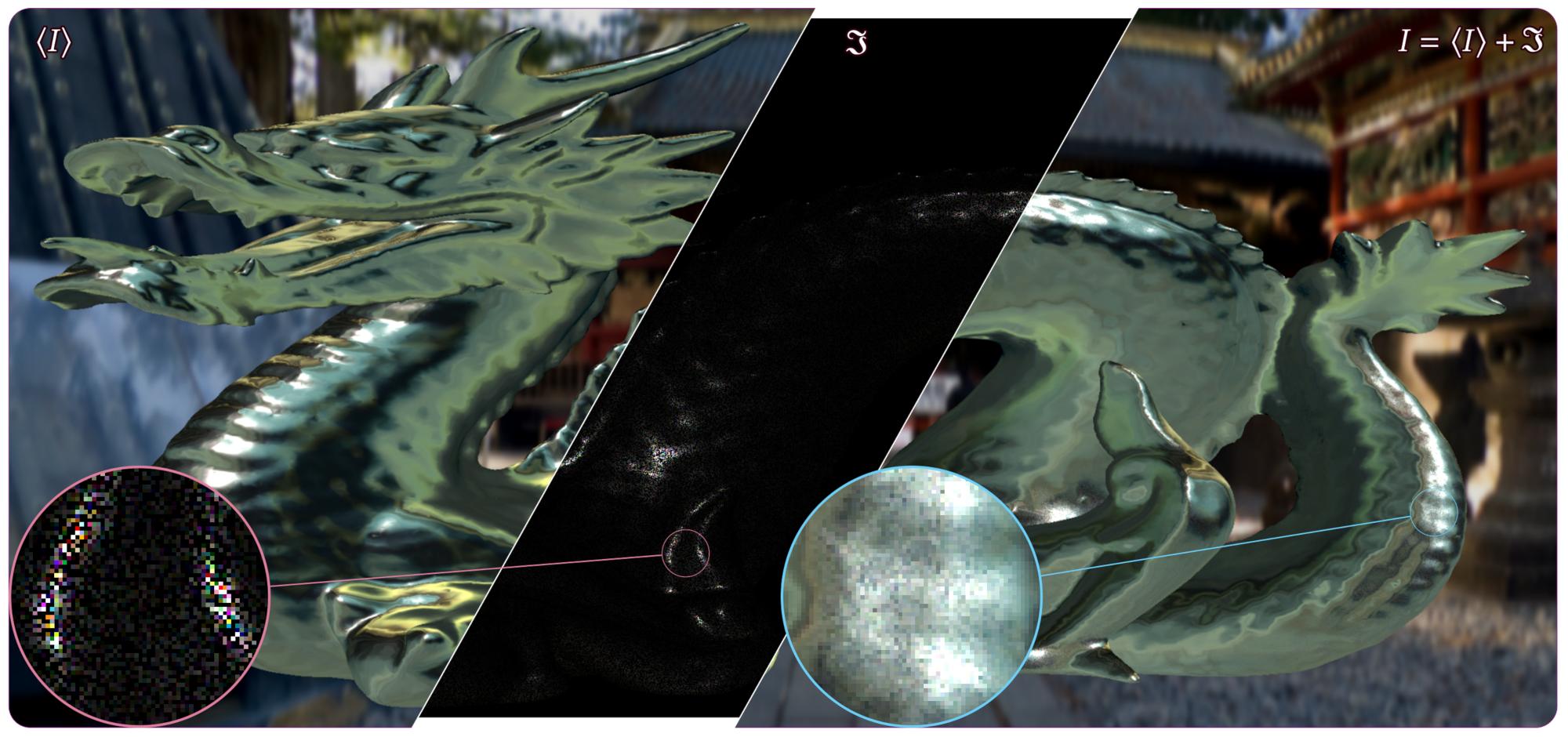
Tremendous effort has been extended by the Computer Graphics community to advance the level of realism of material appearance reproduction by incorporating increasingly more advanced techniques. We are now able to re-enact the complicated interplay between light and microscopic surface features—scratches, bumps and other imperfections—in a visually convincing fashion. However, diffractive patterns arise even when no explicitly defined features are present: Any random surface will act as a diffracting aperture and its statistics heavily influence the statistics of the diffracted wave fields. Nonetheless, the problem of rendering diffractions induced by surfaces that are defined purely statistically remains wholly unexplored. We present a thorough derivation, from core optical principles, of the intensity of the scattered fields that arise when a natural, partially coherent light source illuminates a random surface. We follow with a probability theory analysis of the statistics of those fields and present our rendering algorithm. All of our derivations are formally proven and verified numerically as well. Our method is the first to render diffractions that produced by a surface described statistically only and bridges the theoretical gap between contemporary surface modelling and rendering. Finally, we also present intuitive artistic control parameters that allow rendering of physical and non-physical diffraction patterns using our method.- wave
- speckle
- coherent
- partially-coherent
- rendering
- scattering
- statistical surfaces
- appearance reproduction
- monte carlo
- BSDF
Corrigendum
- In Eq. 55 (Appendix D), all instances of $\eta$ should be $\eta^2$. The square is missing.

Cite this work
Shlomi Steinberg, Ling-Qi Yan. 2022. Rendering of Subjective Speckle Formed by Rough Statistical Surfaces. ACM Transactions on Graphics, 41(1), Article 2. https://doi.org/10.1145/3472293
View BibTeX
@article{Steinberg_Speckle_2021,
  address = {New York, NY, USA},
  articleno = {2},
  author = {Shlomi Steinberg and Ling-Qi Yan},
  doi = {10.1145/3472293},
  issn = {0730-0301},
  issue_date = {February 2022},
  journal = {ACM Transactions on Graphics},
  keywords = {wave, speckle, coherent, partially-coherent, rendering, scattering, statistical surfaces, appearance reproduction, monte carlo, BSDF},
  number = {1},
  numpages = {23},
  publisher = {Association for Computing Machinery},
  title = {{Rendering of Subjective Speckle Formed by Rough Statistical Surfaces}},
  url = {https://ssteinberg.xyz/2022/01/26/rendering_subjective_speckle/},
  volume = {41},
  year = {2022},
}