EUROGRAPHICS 2026
Wave Tracing: Generalizing The Path Integral To Wave Optics
Abstract
Modeling the wave nature of light and the propagation and diffraction of electromagnetic fields is crucial for the accurate simulation of many phenomena, yet wave simulations are significantly more computationally complex than classical ray-based models. In this work, we start by analyzing the classical path integral formulation of light transport and rigorously study which wave-optical phenomena can be reproduced by it. We then introduce a bilinear path integral generalization for wave-optical light transport that models the wave interference between paths. This formulation subsumes many existing methods that rely on shooting-bouncing rays or UTD-based diffractions, and serves to give insight into the challenges of such approaches and the difficulty of sampling good paths in a bilinear setting. With this foundation, we develop a weakly-local path integral based on region-to-region transport using elliptical cones that allows sampling individual paths that still model wave effects accurately. As with the classic path integral form of the light transport equation, our path integral makes it possible to derive a variety of practical transport algorithms. We present a complete system for wave tracing with elliptical cones, with applications in light transport for rendering and efficient simulation of long-wavelength radiation propagation and diffraction in complex environments.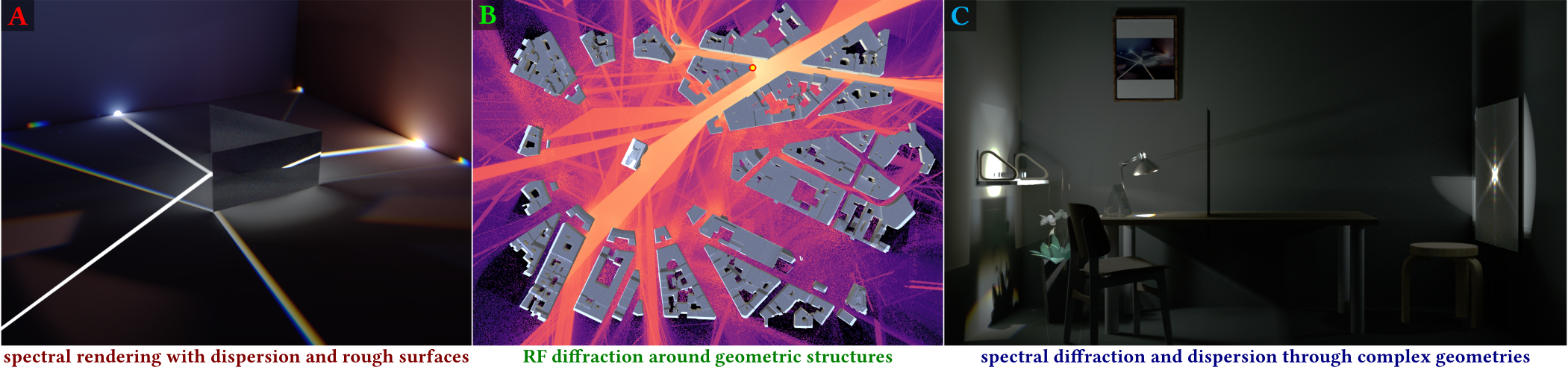
Recognition
- EUROGRAPHICS 2026 Günter Enderle Best Paper Awards Honorable Mention
EUROGRAPHICS talk
Cite this work
Shlomi Steinberg, Matt Pharr. 2026. Wave Tracing: Generalizing The Path Integral To Wave Optics. Computer Graphics Forum, e70322. https://doi.org/10.1111/cgf.70322
View BibTeX
@article{steinberg_wavetracing_2026,
  author = {Shlomi Steinberg and Matt Pharr},
  doi = {10.1111/cgf.70322},
  journal = {Computer Graphics Forum},
  keywords = {wave, optics, simulations, path tracing, light transport, diffraction, plt, rendering, coherence, cone tracing, utd},
  pages = {e70322},
  title = {{Wave Tracing: Generalizing The Path Integral To Wave Optics}},
  url = {https://ssteinberg.xyz/2025/08/28/generalizing_the_path_integral/},
  year = {2026},
}